Home

FEATURED SHOW
“Encounters in the Milky Way”

DiscoverĀ theĀ chanceĀ encountersĀ thatĀ haveĀ shapedĀ ourĀ placeĀ inĀ theĀ universe.

Reaching billions of years into the past and peering millions of years into the future,
Encounters in the Milky Way is a time-traveling journey about the cosmic movements
that shape our galactic neighborhood.

Narrated by Pedro Pascal, witness spectacular moments in our solar system’s past and future, including the paths of stars, comets, interstellar debris,
and visually stunning gas and dust clouds–and, visualized for the first time, a dramatic, ongoing merger of our galaxy with a smaller satellite galaxy.

Developed by a team that includes astronomers, science visualization experts, and artists, Encounters in the Milky Way is made possible by data
from one of the most transformative projects of the past century:
the European Space Agency’s Gaia mission, dubbed the “billion-star survey” for mapping the precise positions, distances, and motions of nearly 2 billion stars in our galaxy.

Encounters in the Milky Way was developed by the American Museum of Natural History (amnh.org) with the major support and partnership of the
National Aeronautics and Space Administration (NASA).
Superior Technology

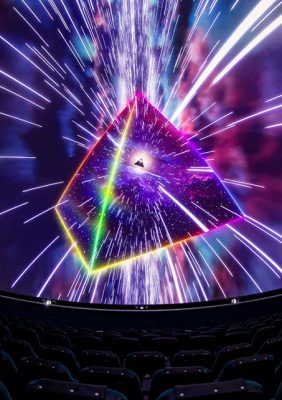
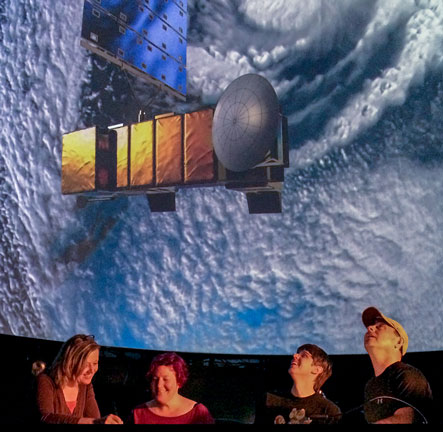
Sky-Skan beautifully orchestrates every element of the planetarium experience, from live science simulation and fulldome cinema playback, to external device automation and show control, all in one elegant, seamless, flexible user interface. We use the best hardware available.

Used & Supported Everywhere

We’ve installed hundreds of fulldome digital systems in museums, universities, and schools around the world. Via online user forums, our client community shares information and resources. When problems arise, our field service engineers come to you, via remote login access or in person.

Affordable & Sustainable

Digital planetariums once used custom projectors and costly mainframe computers. In 1998 Sky-Skan premiered the world’s first fulldome system based on affordable hardware. Since then we have led the way with a constant stream of innovations and milestones. Today, we won’t offer a ā€œsolutionā€ until we understand your unique goals and resources.

A Passion for Planetariums

We Understand You Because We ARE You!

Since 1967 Sky-Skan has helped planetariums be awesome and remain relevant. We provide wonderful tools to help our clients inspire and inform learners of all ages. We’ve brought more innovation to the field than any other company. Equipping planetariums for success, via great systems and shows, is all we do! We are motivated by a love for the field and a deep understanding of its practitioners, because we are planetarians ourselves.

Some Places where Our Team Members have Worked: Arizona Science Center, Armagh Planetarium, Arthur Storer Planetarium, Audio Visual Imagineering, Bishop Planetarium, Carnegie Science Center, Davis Planetarium, Emera Astronomy Center, Exploration Place, Fels Planetarium, Fiske Planetarium, Forum der Technik Munich, Hayden Planetarium, Image Engineering, Infoversum, McDonald Observatory, Museum of Science Boston, National Radio Astronomy Observatory, National Space Science Centre, Planetarium de Bretagne, PlanĆ©tarium of the CitĆ« des Sciences et de l’Industrie, Rauch Planetarium, Space Telescope Science Institute, Spitz, Inc., Strasenburgh Planetarium, Sudekum Planetarium.

Put our Passion to Work for You

Happy Clients

Great Shows

New Additions to the Sky-Skan Catalog

Why Sky-Skan?

All digital planetariums are made of computers, projectors, cables, and software.

Like our competitors, we achieve a long list of technical specifications (nearly all of which we pioneered), but what makes Sky-Skan systems truly special are the details by which the technology melds into a unified instrument for visualizing nature beautifully, and for engrossing, immersive, visual storytelling that interprets the universe in unforgettable ways.

Revitalized for todayā€˜s challenges, Sky-Skan is eager to create a wonderful planetarium for you.

Sky-Skan Clients Enjoy...

  • Detailed architectural and system design and documentation
  • Superb commissioning, on-boarding, training, and continuing support
  • Splendid star fields and science visualization
  • Detailed spacecraft models and space mission vigniettes
  • Rich, cinema-quality surround sound
  • Great shows, scripts, and curriculum materials
  • Flexible user controls and programming interfaces
  • Manual controls as desired
  • Rolling upgrades that keep a system state-of-the-art
  • Support for external media inputs and 3rd party fulldome apps
  • Colorful, long-lasting, smooth-fading cove lighting
Begin the Planetarium Design Process

Calendar

Upcoming Events:

  • June 18-26, 2026: International Planetarium Society (IPS) Meeting, Fukuoka, Japan
  • June 30, 2026: Asteroid Day
  • July 15-17, 2026: Fulldomefestival Jena, Jena, Germany
  • September 16-19, 2026: Association of Science and Technology Centers (ASTC), Phoenix, AZ, USA

Past Events:

  • June 02-04, 2026: Ecsite Conference, Gothenburg, Sweden
  • May 26-28, 2026: Fulldome Festival Brno (FFB), Brno, Czech Republic
  • April 23-26, 2026: Domefest West, Boulder, CO, USA
  • April 18-20, 2026: Annual meeting of German Planetariums (GDP), Kiel, Germany
  • October 07-11, 2025: GLPA + WAC, St. Paul, MN, USA
  • September 26-28, 2025: British Association of Planetaria Meeting, Newcastle, UK
  • September 24-26, 2025: Association of French Speaking Planetariums Meeting, Genk, Belgium
  • September 16-20, 2025:Ā  GSCA ,Ā Texas, USA
  • September 10-12, 2025: Nordic Planetarium Association (NPA) Meeting, Tartu, Estonia
  • September 05-08, 2025: Association of Science and Technology Centers (ASTC), San Francisco, CA, USA
  • July 18-25, 2025: International Planetarium Society (IPS) Meeting, Jena & Berlin, Germany
  • June 30, 2025: Asteroid Day
  • June 10-12, 2025: Fulldome Festival Brno (FFB), Brno, Czech Republic
  • June 3-5, 2025: Ecsite Conference, Warsaw, Poland
  • May 15-18, 2025: Fulldomefestival Jena, Jena, Germany
  • May 7, 2025: Official Birthday ā€œ100 Years of Planetariumsā€ and closing events for the celebrations
  • May 1-4, 2025: Domefest West, Boulder, CO, USA
  • April 25-29, 2025: Starmus VIII, La Palma, Spain
  • April 11-13, 2025: Annual meeting of Italian Planetariums (PlanIT), Matera, Italy
  • April 5-7, 2025: Annual meeting of German Planetariums (GDP), Halle, Germany
  • February 4-5, 2025: Australian Planetarium Society (APS) Meeting Cosmos Centre, Charleville, Queensland
  • February 6-8, 2025: AstroFest, London, UK
  • February 4-7, 2025: ISE, Barcelona, Spain
  • January 31 – February 2, 2025: Dome Under Festival Museums, Victoria, Melbourne, Australia